
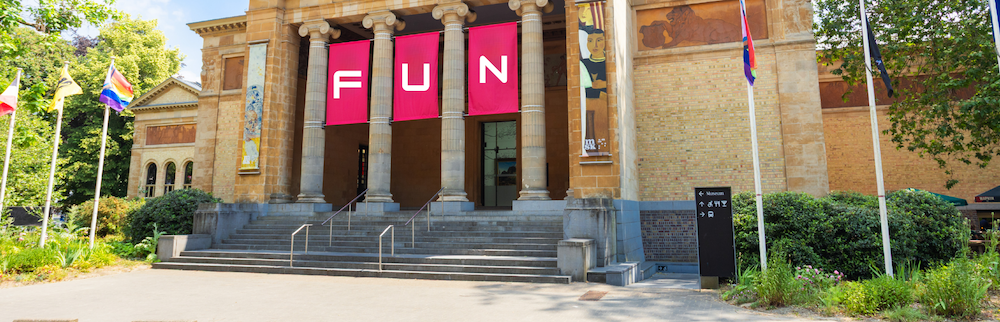
When most people think about museums, certain words naturally come to mind: art, history, culture, science, preservation, education. Depending on the museum, perhaps beauty, scholarship, or even reverence.
Fun rarely makes the list.
If it appears at all, it often arrives as an afterthought—a pleasant bonus rather than a central feature of the experience. Museums, after all, are places where serious things happen. They preserve our collective heritage. They introduce us to complex ideas. They help us grapple with difficult histories and profound questions about what it means to be human and to express that humanity.
All of that is true. And yet I increasingly find myself making a case that can sound strangely radical in museum circles: museums should be more fun.
Not because fun is the highest goal. Not because every exhibition should be transformed into an immersive playground. And certainly not because there is no place for seriousness in museum spaces. Some collections and exhibitions demand contemplation, grief, discomfort, or deep reflection.
My argument is something subtler than that.
I believe fun matters because it helps create the conditions under which all of those other things can happen.
Museums do not fulfill their mission when people merely acknowledge their value from a distance. They fulfill their mission when people visit. And ideally, people visit not only once on vacation, but return to them repeatedly, building an ongoing relationship with ideas, objects, stories, and with one another. A museum that is respected but rarely visited has achieved something far less meaningful than a museum that becomes woven into the rhythms of community life.
This is one of the reasons I founded Museumazing. At its core, this project is built on a simple conviction: museums are uniquely powerful places for helping people think differently. They invite us to notice details we might otherwise overlook. They encourage us to make connections between seemingly unrelated ideas. They allow us to experiment with perspectives beyond our own. And, through all of this, they often lead us toward a deeper understanding of ourselves.
These are not small outcomes. In fact, they are some of the capacities our world needs most. If we want to engage with the more serious content in museums in earnest and achieve something meaningful, we first have to build these skills through repeat exposure.
But there is an important truth that museum professionals, educators, and lifelong museum lovers sometimes overlook: people tend to return to experiences they enjoy.
The relationship between fun and learning is often framed as a trade-off, as though increasing one necessarily diminishes the other. Yet in practice, the opposite is often true. The experiences that shape us most deeply are frequently the ones that combine intellectual substance with genuine delight.
Fun is not the enemy of meaningful engagement. Often, it is the reason meaningful engagement continues.
It’s not unlike the ways we can exercise our bodies. We all know movement is important for our health, but there is a reason fitness experts encourage people to find activities they genuinely enjoy. The perfect workout plan on paper is worthless if you dread every minute of it and abandon it after three weeks.
I know this from personal experience. Running and I have never managed to become friends. I’ve tried repeatedly, convinced that this would finally be the chapter of my life when I learned to love it. Every attempt ends the same way: abandonment. Meanwhile, I can happily lose myself in dance cardio or a strength workout set to great music and hardly notice the time passing.
The benefits are similar. The experience is not.
Enjoyment matters because enjoyment is what brings us back.
Museums operate under the same principle. The goal is not to make every museum visit lighthearted. The goal is to create experiences that people want to repeat because at some level, they feel good. When people return, they encounter new ideas. They deepen old questions. They discover fresh connections. They continue the lifelong process of making meaning.
Fun is not a distraction from that work. It is often what sustains it.
What Does Fun Actually Look Like?
This is usually the point where people begin imagining flashing lights, gamified exhibits, or museums desperately trying to compete with theme parks and TikTok.
That isn’t what I’m talking about. In fact, most museum fun is surprisingly quiet.
To understand what I mean, think about the difference between gym class and recess.
Gym class has a prescribed activity. Someone else decides what you’re supposed to do. There are rules, objectives, and perhaps even a grade waiting at the end.
Recess feels different. You choose your own adventure. You decide where your attention goes. The structure is lighter, even for the games with rules. The possibilities are wider. Nobody is worried about whether they are doing recess correctly or getting a bad grade.
Many museum visitors unknowingly approach museums as though they’re going to gym class.
They feel obligated to see everything. They try to read every label. They worry about understanding the “right” interpretation. They leave exhausted, having spent three hours trying to complete a task that was never actually assigned.
One of the most liberating shifts a visitor can make is recognizing that museums are much closer to recess than gym class.
The first step is giving yourself permission to follow your curiosity.
This may be the most controversial piece of museum advice I give: read less.
At least at first. To be clear, I love museum labels. But many visitors rush to read someone else’s interpretation before they’ve had a chance to form their own. They arrive at an object and immediately look for instructions and answers.
What if, instead, you paused?
What if you noticed what caught your eye before looking for an explanation?
What if you allowed yourself to wander toward the object that genuinely interested you, rather than the one the map suggests is most important?
When I work with students, I often tell them to let curiosity be their compass.
Adults need that reminder just as much as children.
Fun also emerges through small challenges that encourage deeper looking and richer thinking. These are what I think of as the museum equivalent of recess games. They are simple enough to learn in seconds and flexible enough to adapt to whatever gallery you happen to be exploring.
Can you find the strangest object in the room?
Which artwork would you most want to hang in your home?
How many shades of blue can you spot in this gallery?
If this artifact could talk, what story would it tell?
The goal is not to distract yourself from the museum. The goal is to notice more of it.
This distinction matters because many museum activities accidentally pull visitors away from the very things they came to see. As someone who has spent years working in museum education, I will admit to having two longstanding nemeses: museum word searches and museum crossword puzzles.
These activities are easy to create, but they often focus attention on a piece of paper rather than on the remarkable objects surrounding the visitor. The best museum games do the opposite. They direct your attention back toward the collection. They invite you to look more closely, think more deeply, and build a personal connection with what is in front of you.
Fun also grows through shared experiences.
Museums are often treated as quiet places for individual contemplation, and certainly there are moments when solitude is part of the experience. But museums can also be extraordinary places for conversation.
Some of my favorite museum memories involve standing beside another person and comparing what we noticed, debating interpretations, sharing questions, or laughing at an unexpected observation. One whispered exchange in a gallery can transform a passive visit into a memorable one.
And perhaps that is the key. Fun in museums is rarely about spectacle. More often, it emerges through attention, curiosity, and connection.
Beyond Fun
When I say museums should be more fun, I don’t actually mean that they should become more entertaining.
Entertainment is easy to find.
What museums offer is something rarer.
A truly great museum experience creates room for play. Not the kind that requires toys or costumes or flashing lights, but the kind that allows us to experiment with ideas. To make unexpected connections. To ask questions without worrying whether we’re asking the “right” ones. To follow our curiosity somewhere unexpected and see what happens.
In that sense, museums can be profoundly playful places.
The best museum experiences are also joyful. Not because every object tells a happy story or every exhibition leaves us smiling, but because there is a particular kind of satisfaction that comes from feeling fully engaged with the world. Joy often emerges from connection—from seeing something that moves us, from sharing an observation with a friend, from recognizing a piece of ourselves in a story that began centuries ago.
And perhaps most importantly, museums can be wonderful.
I don’t mean “wonderful” as a synonym for good. I mean it in the older sense of the word: full of wonder.
Museums are one of the few places in modern life specifically designed to help us encounter things that are larger than our everyday routines. They invite us to stand in the presence of extraordinary creativity, remarkable histories, astonishing natural phenomena, and perspectives far beyond our own. They remind us that the world is bigger, stranger, and more interesting than we often remember.
Fun is not the destination. It’s the doorway.
It’s what helps people feel welcome enough to enter, comfortable enough to stay, and engaged enough to return.
And when they do return, again and again, something remarkable becomes possible. Museums cease to be places we occasionally visit out of obligation or cultural virtue. They become places where we think, connect, imagine, question, create, and grow.
In my ideal world, those are the qualities people would associate with museums, seeing them not only as educational or as capital-I Important. They’re so much more than that. They’re playful! Joyful! Wonderful!